Bolds the start of each word as a visual anchor. Helps some people focus; off by default.
Font
Module 6 · Part One
Fascia, the Communication Organ
(the part of you no one ever explained)
Lesson 1 of 4
Listen to this lesson
Narration coming soon
A note before we begin. You deserve to understand the body you live in, not just to be told to stretch more. We will move through this gently, a little at a time, at whatever pace your body asks for. There is nothing here to memorize, and nothing waiting to be tested. Each piece will still be here for you whenever you return to it.
Module 6 · Lesson 1
The Organ You Were Never Told You Had
There is a part of you doing an enormous amount of quiet work, and almost no one ever tells you it exists.
It is called fascia. If you have heard the word at all, you were probably told it is the packing material of the body, the filmy stuff between the real parts, the wrapping around a muscle. That is what I was taught too, decades ago, that fascia was just a container, a way to keep things tidy in their compartments. We were wrong. Fascia is not the packaging. It may be one of the most important organs you have.
Fascia is not the spaces between the real things. It may be the realest thing of all.
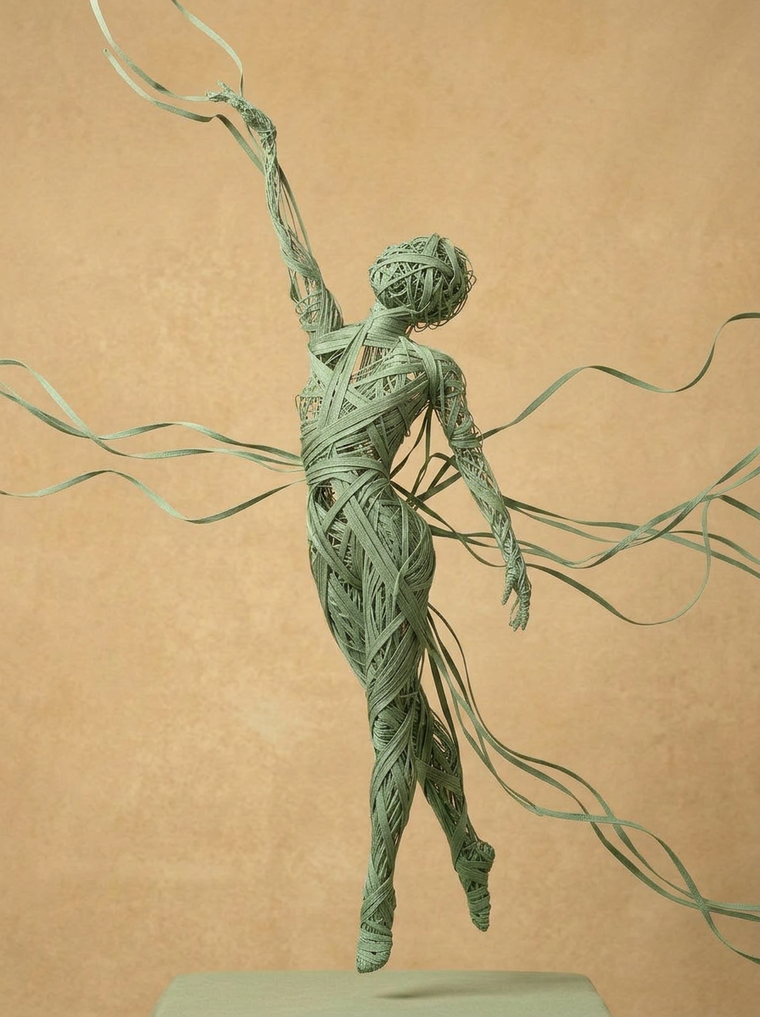
Picture a single, continuous web, threaded through your entire body. It wraps every muscle, yes, but it does not stop there. It wraps the next muscle, and the next, and it weaves around your organs and along your bones and just beneath your skin, one unbroken fabric from the crown of your head to the soles of your feet. There is no part of you it does not touch. You are, in a very real sense, held together by a single living net.
You, as a single continuous web. An artistic impression of fascia, the living net that threads through and beyond every part of you.
For a body like ours, this changes everything about how we understand pain, and movement, and why your symptoms travel the way they do. So let me show you what this web actually does.
Module 6 · Lesson 2
The Body's Communication Network
Fascia is not a passive net. It is alive, and it is talking, all the time.
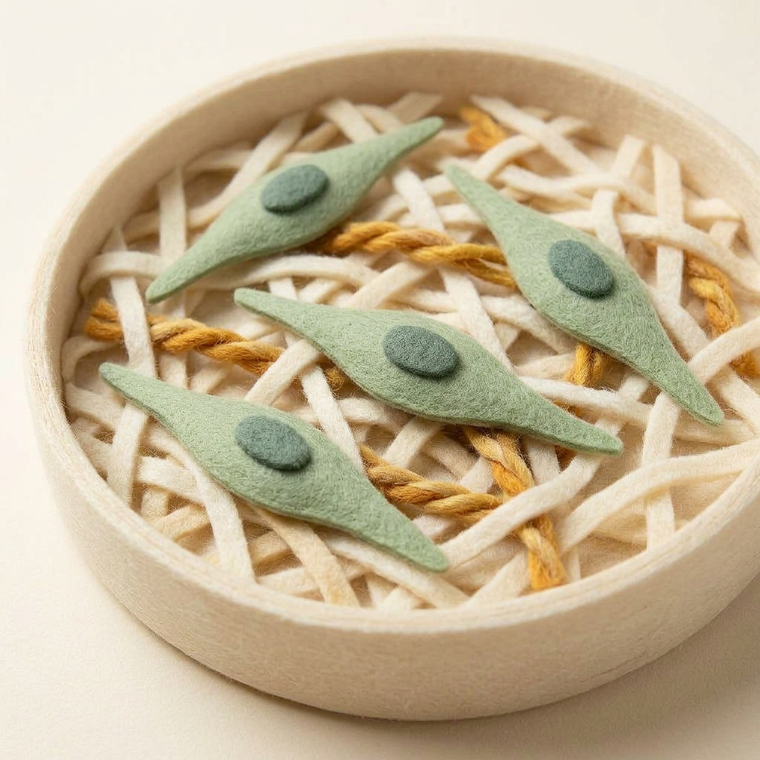
It is woven through with nerves, far more of them than anyone once realized, which means it is in constant conversation with your nervous system, sending a steady stream of information about where you are, how much tension you carry, what is happening in every corner of you. It is also a transit system. Through the fluid and the fibers of that web, signals travel, nutrients move inward to your cells, and waste is carried outward, by routes that do not even need your blood vessels or your nerves to carry them. It is, quietly, one of the great communication and delivery networks of your whole body.
Here is the part that moves me, and I think it may move you too. That web is a smaller echo of something larger. The fascia carrying messages between your cells mirrors the constant conversation between your nervous system and your body, the very dialogue we have been tracing through this whole course. Communication at the scale of a single cell, and communication at the scale of your whole being, running on the same principle, connection, everywhere, all the time.
You are not a set of separate parts that happen to live in the same body. You are a single, connected, communicating whole.
Module 6 · Lesson 3
How Fascia Helps You Hold Together
Fascia does something else that matters enormously for a body like ours. It helps hold you together.
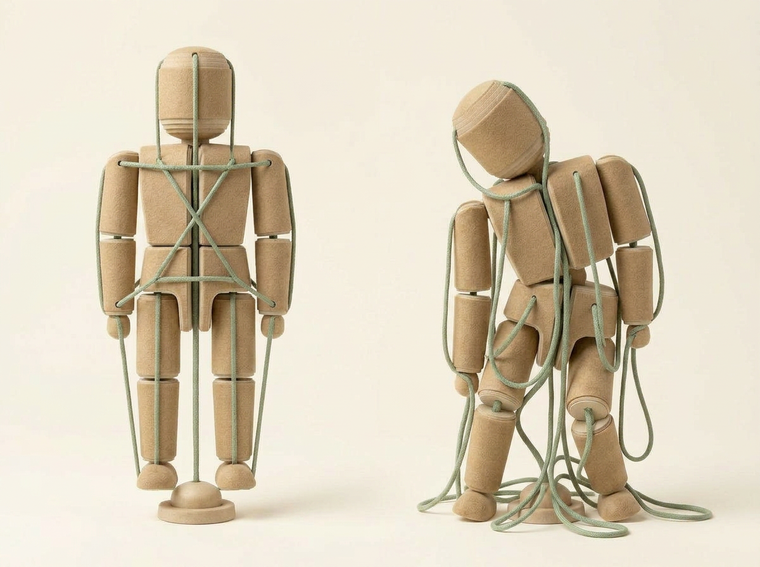
There is a principle called tensegrity, the way a structure can stay stable through a balanced web of tension rather than through rigid stacking. Think of one of those sculptures held together by taut wires, where the solid pieces seem to float, suspended in a net of tension that keeps everything in its place. Your body works far more like that than like a stack of bricks. Your bones do not simply pile on top of each other. They are suspended and balanced within the tensioned web of your fascia.
Held by balanced tension, not rigid stacking. When the web of tension is balanced, the figure stands. When it loses that tension, the whole structure collapses.
This is a gift, and a quiet kind of hope, because in a body like ours the ligaments and joint capsules that are meant to give passive stability are looser and less reliable. The fascia is another structural layer entirely, one we can actually train. When you lengthen, when you feel yourself grow tall and press gently down through your feet, you are calling on that fascial tension to help support you. You are recruiting a whole system of stability that traditional approaches almost never think to use.
Your stability was never only about muscles and ligaments. You have a whole living web of support, and we can teach it to show up for you.
Module 6 · Lesson 4
Why Yours Gets Stuck
Now, the part that explains so much of what you feel. You might expect that a body with looser connective tissue would have looser, more slippery fascia. It is usually the opposite.
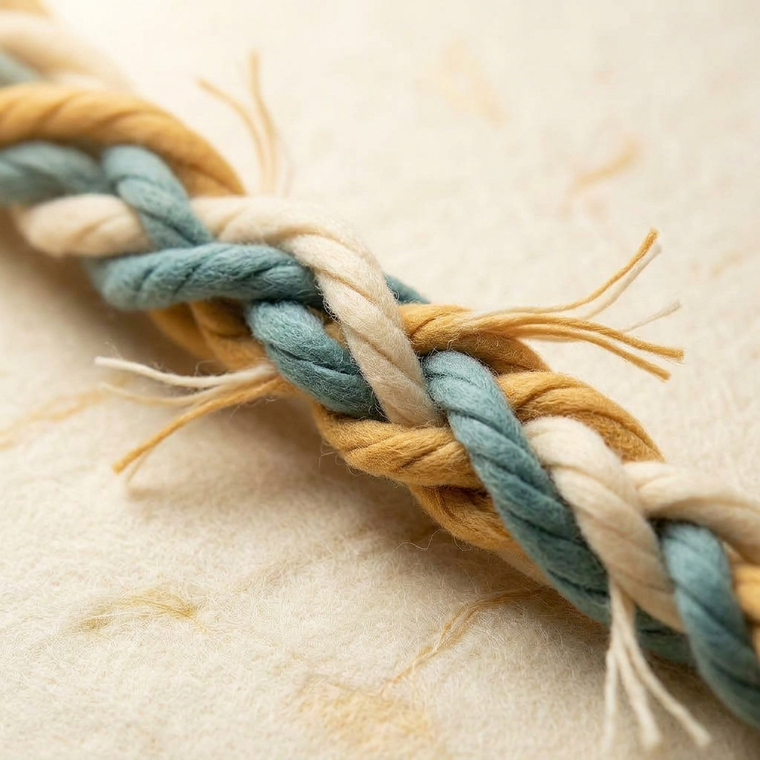
Healthy fascia is meant to glide, smooth and well hydrated, sliding easily as you move. In connective tissue disorders, it tends to get stuck instead, adhering down in places, losing its slide. A great deal of that comes from inflammation, the low and ceaseless simmer we will look at closely in the very next module, which lays down a kind of internal stickiness over time. So a body that seems like it should be too loose ends up, in its fascia, too stuck.
Here is why that matters so much, and it is one of my favorite ways to picture it. Imagine a fitted sheet pulled smooth across a bed. Now reach down and twist up just one corner of it. Watch what happens. The whole sheet pulls. Wrinkles run all the way across to the far corners, nowhere near where you twisted. That is fascia. When it gets stuck down in one spot, it pulls on everything connected to it, which is everything. A restriction in one place can surface as pain or pulling or stiffness somewhere else entirely, somewhere that seems to have nothing to do with it.
This is why your pain travels. Why the thing that hurts is so often not the thing that is stuck. Your body was never being random. It was being connected.
So when we work, we are never only working the spot that hurts. We are tending the whole web, helping it rehydrate and glide and let go, so the pull eases everywhere at once. Next, we look closely at the engine behind so much of that stickiness, the mast cells, and the quiet inflammation they drive. I will meet you there.
Your Take-Away
Where My Pain Travels. A simple body map for tracing the pull. You mark where it hurts, then where it might actually be tugging from, so you can start to see your own web instead of chasing the spot. Remember the fitted sheet. The thing that hurts is so often not the thing that is stuck.
Module 1 is yours to explore freely. The rest opens when you enroll in The Movement Primer, the live group program, and it stays yours, to revisit at whatever pace your body asks for.