Bolds the start of each word as a visual anchor. Helps some people focus; off by default.
Font
Module 10 · Part One
The Neck & the Upper Cervical Story
(why so much runs through one small place)
Lesson 1 of 5
Listen to this lesson
Narration coming soon
A note before we begin. This is a tender subject, and one that carries a lot of fear in our community, so we will move through it with extra care. My hope is that you leave this module with more calm than you came in with, not less. There is nothing here to memorize, and nothing waiting to be tested. Each piece will still be here for you whenever you return to it.
Module 10 · Lesson 1 of 5
Where Head Meets Spine
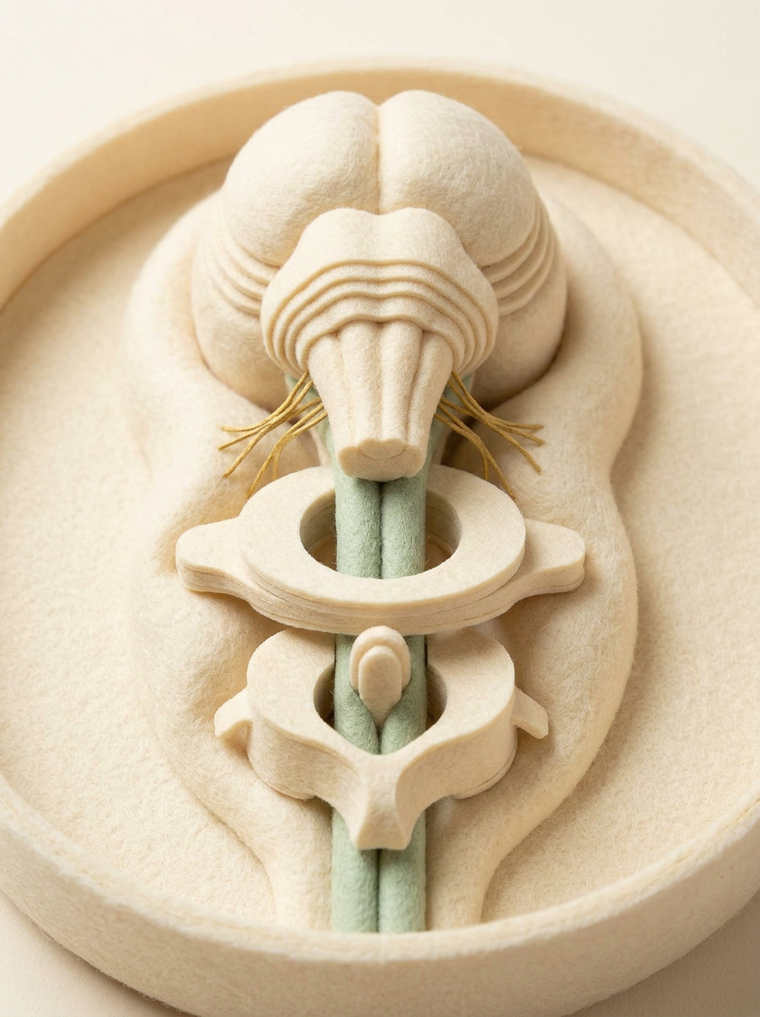
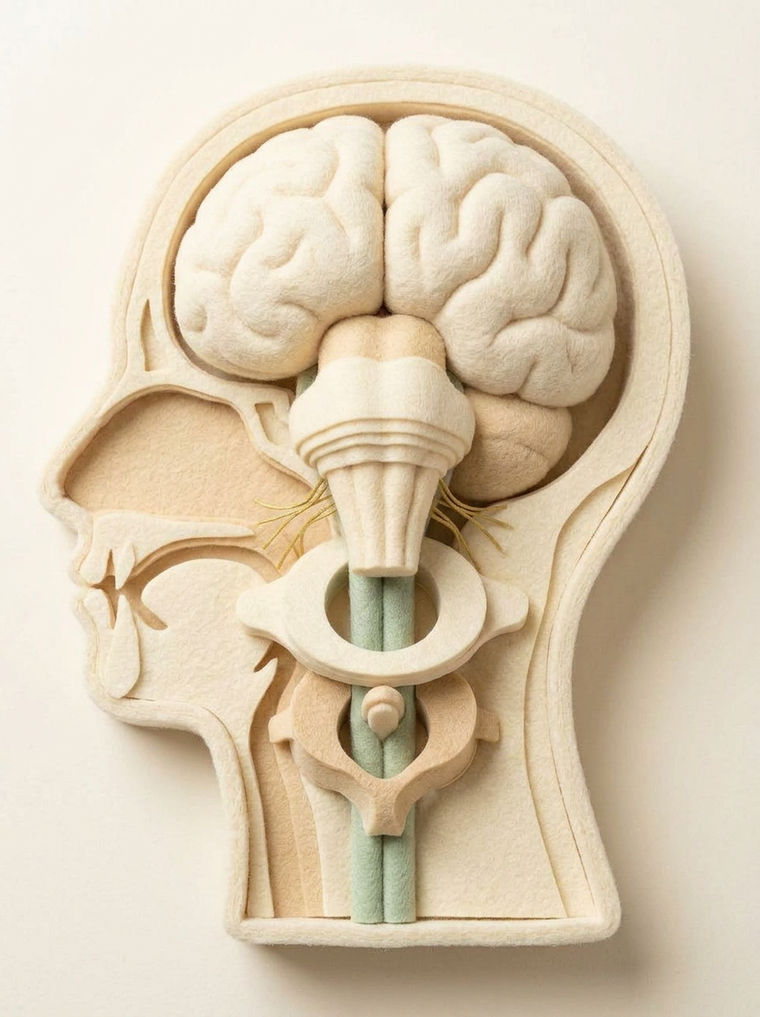
Right at the very top of your spine, where your skull settles down onto your neck, sits the most remarkable and most vulnerable joint in your entire body. Two small bones do nearly all of the work. The atlas, which cradles the skull like a pair of cupped hands, and the axis just beneath it, which lets you turn your head to look over your shoulder.
This is a genuine marvel of engineering. It holds up a head that weighs as much as a bowling ball, ten to twelve pounds, all day long. At the same time it lets that head nod and turn and tilt through an enormous range of motion. To pull off both jobs at once, to be stable and mobile in the same breath, it leans far more on its ligaments than on the shape of the bones. Lower in your spine, the bones interlock for safety. Up here, the ligaments hold the line almost on their own.
So now you can see the difficulty before I even name it. When your connective tissue is more elastic than most, the very ligaments this joint leans on are the ones most likely to give a little extra. The one place in your whole spine that trusts its ligaments the most is the one place your body is least able to guarantee them. It is the same web we have followed all along, simply arriving at its most delicate corner.
This was never carelessness on your part. It is anatomy, meeting a body that builds its scaffolding a little softer than the instructions assumed.
Module 10 · Lesson 2 of 5
Why the Neck Speaks So Loudly
Here is the question that explains so much. Why would one small joint cause symptoms that reach so far, into your head, your gut, your heart, your very sense of steadiness? The answer is what lives inside and just behind it.
This is the region of the brainstem, the place where your brain narrows down and becomes your spinal cord. The brainstem is the switchboard for everything you never have to think about. Your heart rate, your blood pressure, your breathing, your digestion. The vagus nerve, that great calming nerve we keep returning to, passes right through this same neighborhood on its way out to the rest of you.
So the upper neck is not merely a joint. It is the crossroads where the entire conversation between brain and body funnels through one narrow gate. When this area is irritated, or quietly working overtime to hold itself steady, the signals crossing it can turn noisy. That noise can surface as headaches at the base of the skull, as brain fog, as dizziness, even as a flare of the same dysautonomia we met in the POTS module. The neck was never shouting at random. It sits on top of the wires.
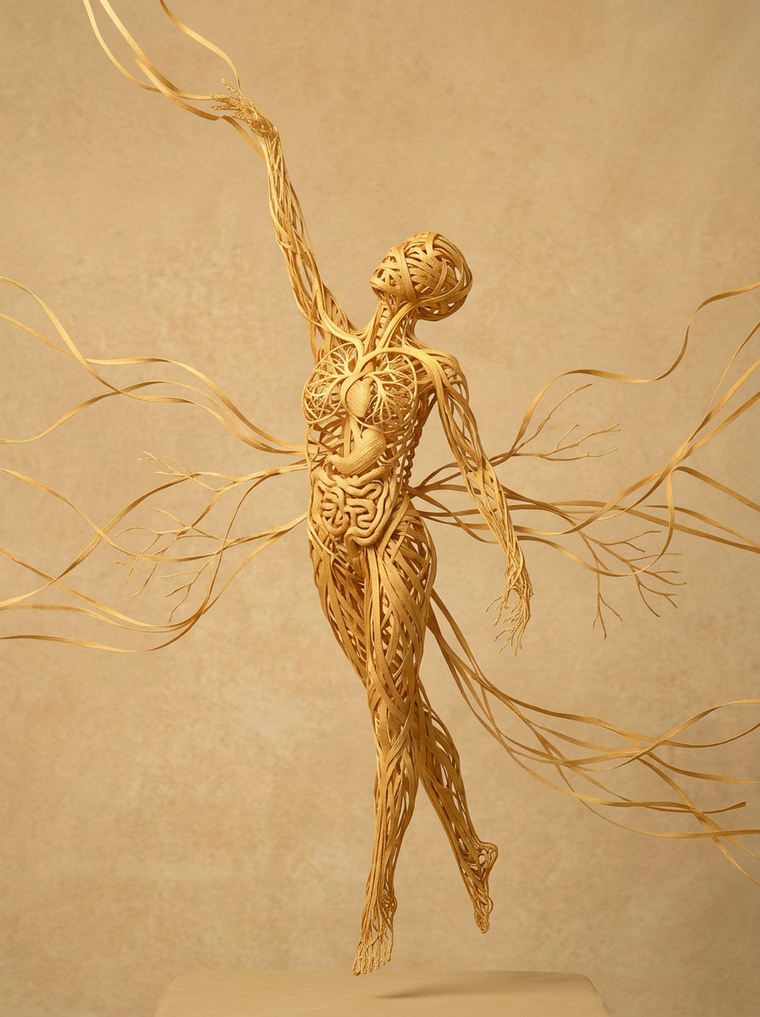
Artistic impression. The vagus and its branches, imagined as fine threads reaching through the whole body from that upper gateway.
Hold one more thing in mind. Keeping your head upright all day is one of the quietest, most constant demands your body answers. We have called it the threat of simply existing against gravity. For a neck that has to work a little harder to feel steady, that ordinary, endless task can become a low background effort you feel building as the hours pass.
Module 10 · Lesson 3 of 5
The Coat-Hanger Clue
There is a particular pain pattern here with a name that tells you its shape. It drapes across the base of the skull, runs down the back of the neck, and spreads out over the tops of both shoulders, in the exact outline of a coat hanger. If you live with it, you knew it by the third word of that sentence.
Now the part that gets missed again and again, and the part I most want you to carry out of this module. When people meet this pain, many leap straight to the worst fear, that the joints at the top of their neck are failing. The reassuring truth is that most of the time, coat-hanger pain is not a story about unstable joints at all. It is a story about blood flow.
Picture those muscles running up the back of your neck. They are anti-gravity muscles, working softly and without rest to keep your head from dropping forward. Muscles can only do that with a steady delivery of blood. In orthostatic intolerance, in POTS, blood does not always reach where it is needed while you are upright. So those hard-working neck muscles get starved, waste builds up inside them, and they begin to ache. The pain is completely real. Its root, most often, is circulation, not collapse.
important
Coat-hanger pain is far more often a dysautonomia signal than a sign of structural instability. A telling clue is that it tends to ease when you lie down and the blood returns. This also means the very tools that help your POTS, the salt and fluids, the compression, the regulation, will often quiet this pain as well.
The pain that frightens people most into believing their neck is broken is, more often than not, a circulation story, and a far gentler one than they feared.
Module 10 · Lesson 4 of 5
When to Look Closer
Let me set the ground first, because it matters. The vast majority of neck pain and neck symptoms in bodies like yours, even the unsettling ones, are not dangerous, and they respond to gentle, conservative care. Surgery for true instability is genuinely rare, and it is always a last resort, reached only after many other paths have been walked. Please stand on that ground before you read what comes next.
With that said, there is a small handful of signals that do deserve a careful look from a knowledgeable provider. Not because they spell catastrophe, but because they are worth checking and ruling out. Knowing them is not a reason to be afraid. It is a quiet form of power.
Signals worth a closer look: New numbness, tingling, or weakness in the arms or hands. Dizziness or vertigo that comes with changing your head position. Changes in swallowing, speech, or vision. A feeling that your head is too heavy to hold, as though it might bobble on top of your neck. Symptoms that are clearly worsening over time rather than holding steady.
If you recognize several of these, the neurological ones especially, let that be your cue to bring them to a physician or a physical therapist who truly understands hypermobility. One honest note worth having. The imaging that shows this region best is specialized, often taken in an upright position, and not every provider thinks to order it. You are allowed to ask for it. You are allowed to keep asking until someone takes the whole picture as seriously as you do.
Module 10 · Lesson 5 of 5
How We Care for It
Here is the hopeful part, and it is most of the story. The upper neck responds beautifully to the right kind of care, and almost none of that care is dramatic.
It begins exactly where everything in this course begins, with regulation. A calm nervous system is a neck's best friend. When your system feels safe, the muscles that have been bracing around your neck can finally loosen their grip, and the whole region settles. We calm the system first, before we ever ask the structure to work. That order is not a detail. It is the whole method.
From there comes gentle retraining. Not strengthening in the gym sense, but coaxing the deep muscles closest to the spine to wake up and quietly do their stabilizing job, while teaching your brain to sense where your head sits in space again. This work is slow and kind, and it is remarkably effective over time.
Then the small daily supports that add up to a great deal. Bring your screen up to eye level so you are not bowing your head for hours. Find a pillow that keeps your neck in a neutral line through the night. Take frequent little breaks from holding your head in any one position. On the hard days, let your neck rest without a shred of guilt.
There is also a place for outside support, like a soft collar, used wisely, for a flare or an especially hard day. Used with intention, it is a real tool. Used constantly, it can quietly teach your own muscles to stop showing up for work. That balance deserves its own careful conversation, which is exactly where we are headed next.
Your Take-Away
My Neck Notes & Daily Supports. A calm two-part page: any signals worth mentioning to your provider, gathered in one place, and a short menu of neck-friendly habits to fold into your days. Awareness without alarm.
Next, we take up the question of supports themselves, the braces, the collars, the aids, and how to tell when a tool is helping you and when it has quietly become a crutch. I will meet you there, whenever your body is ready.
If the preview below is blank, tap Save / Print to open and fill your worksheet. Your lesson is waiting right behind this screen.
Module 1 is yours to explore freely. The rest opens when you enroll in The Movement Primer, the live group program, and it stays yours, to revisit at whatever pace your body asks for.