Bolds the start of each word as a visual anchor. Helps some people focus; off by default.
Font
Module 9 · Part One
Energy, Pacing & Crashes
(why the wall comes down, and how to see it coming)
Lesson 1 of 5
Listen to this lesson
Narration coming soon
A note before we begin. You deserve to understand why your energy works the way it does, instead of being told you just need to push through. We will move gently, a little at a time, at whatever pace your body asks for. There is nothing here to memorize, and nothing waiting to be tested. Each piece will still be here for you whenever you return to it.
Module 9 · Lesson 1 of 5
Why You Crash
If you have ever done a perfectly normal amount of living on a good day, then paid for it hard for the next three, you already know exactly what this module is about. The crash. The wall that seems to come down out of nowhere, long after the thing that brought it on.
I want to begin by saying clearly what this is not. It is not laziness. It is not a lack of willpower. It is not your fault, and it is not simply being out of shape. There is a real, measurable difference in how a body like yours makes and spends energy, and once you understand it, so much of what has confused you starts to make sense.
Deep inside nearly every cell, you have tiny engines called mitochondria. Their whole job is to take food and oxygen and turn them into the usable energy that powers everything you do. In many people with connective tissue conditions, those engines do not refill the way they should. The same low, ceaseless inflammation we traced through the mast cell module taxes them, so the tank runs smaller, and it refills slower. You are not imagining the shortage. You are living inside a different energy economy.
Your energy was never unlimited and then squandered. It was always smaller, and harder won, than anyone around you understood.
Module 9 · Lesson 2 of 5
The Delayed Price
Here is the piece that makes this condition so cruel, and so easy to blame yourself for. The cost of overdoing it does not arrive while you are overdoing it. It arrives a day or two later. This is called post-exertional malaise, and it is the single most defining feature of this kind of fatigue.
Think about what that delay does to you. You feel alright in the moment, maybe even good, so you keep going. You do the thing. The bill does not come due until a day or two on, when you can no longer connect the wave of symptoms to the cause that set it off. So you blame yourself for being weak, when the truth is your body was quietly paying off a debt the whole time.
important
Post-exertional malaise is not ordinary tiredness. It is a whole-body shutdown, wildly out of proportion to the effort, and it can be set off by physical, mental, or even emotional exertion. A hard conversation can cost you the same as a flight of stairs.
I want to linger here, because this is the part almost everyone misses. We are trained to think of exertion as physical, the walk, the chores, the workout. Your energy system does not draw such a tidy line. Concentrating hard, working through a difficult problem, sitting in a tense or emotional situation, managing stress, or simply enduring a loud, bright, crowded room full of sensory input, all of it pulls from the very same tank. Your body does not bill mental and emotional and sensory effort to a separate account. It is one account, and every kind of demand spends from it.
This matters enormously for tracking, so I would gently ask you to count all of it. A draining phone call, a stretch of deep focus, a hard cry, an overstimulating store, these can land you in a crash two days later just as surely as a physical push, and because they never looked like exertion, the connection is the easiest one of all to miss. When you log what cost you, count the invisible effort right alongside the visible kind.
The fatigue that comes with it is its own animal too. It is not the pleasant heaviness of a good day's work. It is bottomless, and sleep often does not touch it. You can wake from a full night still feeling as though you never rested at all.
Module 9 · Lesson 3 of 5
A Flare, or Feedback?
This next distinction may be the most useful thing in the entire module, so I want to slow right down for it. There are two very different experiences that can both feel like getting worse, and they mean opposite things. Learning to tell them apart changes everything about how you move through your days.
The first is feedback. Feedback is your body's normal, gentle conversation about effort. It is mild, it is roughly proportional to what you did, it shows up soon rather than days later, and it eases within a day. The ordinary muscle tiredness of doing a little more than usual. Feedback is not a warning. It is the quiet sound of a body safely adapting, which is to say, getting stronger.
The second is a flare, a crash. That is your body crossing a line and sounding an alarm. It is out of all proportion to the effort, it is often delayed, and it does not stay politely in your muscles. It pulls the whole system in. The brain fog, the sore throat, the racing heart, the bottomless fatigue, all at once. Remember how a mast cell reads any sudden change as a threat. Your whole system does something similar here, treating the overreach as danger and bracing against it.
To tell them apart, ask three questions: Timing, did it land soon or a day or two later? Proportion, does it match what I did, or wildly exceed it? Breadth, is it just tired muscles, or is my whole body lit up? Soon, proportional, and local tends to be feedback. Delayed, disproportionate, and system-wide tends to be a flare.
Feedback says keep going, gently. A flare says you crossed a line, come back. One is an invitation, the other is a boundary.
Module 9 · Lesson 4 of 5
Living Inside the Envelope
Picture your available energy as an envelope with edges. Inside those edges, you can move and do and live, and your body handles it. Push past them, and the price is a crash. Almost everything about thriving with this condition comes down to learning where your envelope sits, and choosing, most days, to live inside it.
Many in this community use the language of spoons for the same idea. You wake with a limited number of spoons, each task costs a few, and once they are gone, they are gone. It is a loved metaphor for a reason. It makes an invisible limit visible, both to you and to the people you are trying to explain it to.
Now the part that turns everything on its head. The way to do more over time is to do less than you can right now. This is the same paradigm inversion that runs through this whole course. Rest is not the empty space between the real work. For a body like yours, rest is the work. It is the thing that slowly widens the envelope, where pushing only tears it.
So pacing is not giving up. Pacing is the strategy. You rest before you are empty, not after. You break the big task into smaller pieces with pauses tucked between them. You stop while you still have a little left in the tank, on purpose, even when it feels silly to stop. That leftover margin is what protects you from the crash.
You are not being asked to want less from your life. You are being shown how to get more of it, by stopping before the wall instead of after.
Module 9 · Lesson 5 of 5
Your Traffic Light
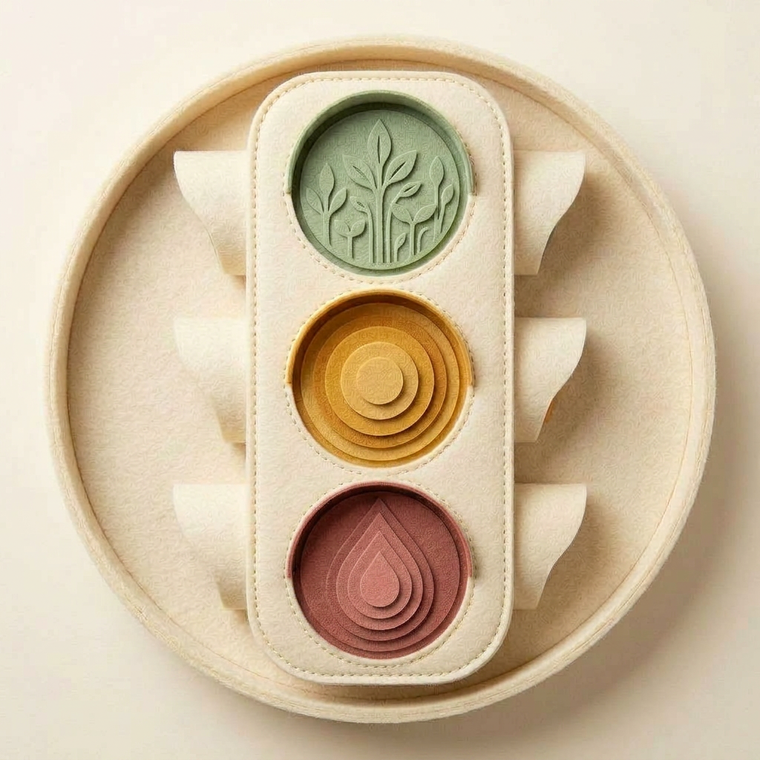
Let me give you a simple way to read yourself in the moment, one you can carry anywhere. Picture a traffic light, green, yellow, red, and learn what each color feels like inside your own body.
Green. You are steady and inside your envelope. Energy feels available, your heart is calm, your mind is clear. This is gentle go. You can move and do, while keeping a little in reserve.
Yellow. The early warning signs, and they are personal to you. A heaviness creeping in, your heart starting to climb, the fog rolling toward your thinking, a flicker of irritability. Yellow means pause, not push. This is the most important color to learn.
Red. The stop signals. You are already over the line. The crash is no longer a risk, it is on its way. Red means rest, with no negotiation and no guilt.
Here is the whole skill in one sentence. Catch yellow before it becomes red. Almost all of us were trained to ignore yellow, to power through it, until red slammed the brakes for us. Learning to honor yellow, to treat that whisper as wisdom arriving early, is the practice of this entire module. It is how you stop living crash to crash and start living inside a life that holds.
Your Take-Away
My Traffic Light. Your own red, yellow, and green signals, written in your own words, so you can read yourself in the moment and catch yellow before it turns red. The whisper before the shout.
My PEM Tracker. A gentle log for the delayed price. You note what you did and what it cost a day or two later, and over time your own envelope, your own line, starts to show itself on paper.
Next, we move to a quiet place that drives more symptoms than almost anyone realizes, the neck, and the delicate story of the upper cervical spine. I will meet you there, whenever your body is ready.
If the preview below is blank, tap Save / Print to open and fill your worksheet. Your lesson is waiting right behind this screen.
Module 1 is yours to explore freely. The rest opens when you enroll in The Movement Primer, the live group program, and it stays yours, to revisit at whatever pace your body asks for.