Bolds the start of each word as a visual anchor. Helps some people focus; off by default.
Font
Module 5 · Part One
Breathing & the Pressure System
(the breath you were never taught)
Lesson 1 of 5
Listen to this lesson
Narration coming soon
A note before we begin. You deserve to understand the body you live in, not just to be told to take a deep breath. We will move through this gently, a little at a time, at whatever pace your body asks for. There is nothing here to memorize, and nothing waiting to be tested. Each piece will still be here for you whenever you return to it.
Module 5 · Lesson 1 of 5
The Breath You Were Never Taught
How many times has someone told you to just take a deep breath, and it did almost nothing, or somehow left you feeling worse?
If that is you, I want you to know it was never a failure of effort, and it was never a sign that you are simply bad at relaxing. Breathing well is not a mood you are supposed to summon. It is a mechanism, a precise and physical set of movements, and for a body like ours that mechanism has very often gone a little sideways. No one ever showed you how it actually works, so being told to just do it landed about as well as being told to just play the piano.
Your breath is not a feeling you are failing to have. It is a movement no one ever taught you.
So in this module we are not going to talk about calming down. We are going to look, honestly and mechanically, at how breathing is built, why it has been so hard for you, and why getting it back is one of the most foundational things we can do together. Your breath turns out to be the quiet engine underneath your stability, your nervous system, and your pain, all at the same time.
Module 5 · Lesson 2 of 5
Think of a Can
Picture a can. Not a flat thing, but a closed cylinder, like a can of your favorite beans, sealed at the top and sealed at the bottom.
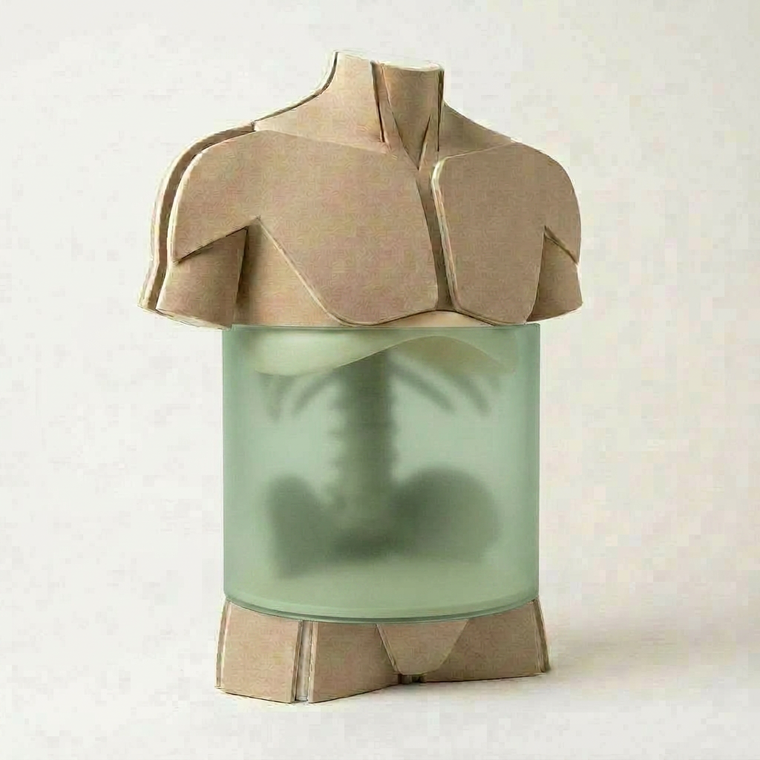
Your core is built almost exactly like that can, and once you can see it, a great deal of your body starts to make sense. The top of the can is your diaphragm, a wide dome of muscle that sits just under your lungs. The bottom of the can is your pelvic floor, a sling of muscle at the very base of your pelvis. The walls of the can, wrapping all the way around the sides, are your deep abdominal muscles, including the transverse abdominis, the very corset we met in the last module.
Your core as a sealed can. Diaphragm on top, pelvic floor on the bottom, the deep corset wrapping the walls.
Your breath and your deep core are not two separate things. They are the top and the sides of the same can.
This matters more than almost anything else I can tell you, because it means breathing is never only about air. Every time you breathe, you change the pressure inside that sealed cylinder, and that pressure is part of what holds you steady from the inside. A can that cannot manage its own pressure cannot hold its shape. That is exactly the trouble a body like ours runs into, and we are about to see why.
Module 5 · Lesson 3 of 5
How the Diaphragm Actually Moves
Here is the part that surprises almost everyone, including me, every single time I stop to picture it.
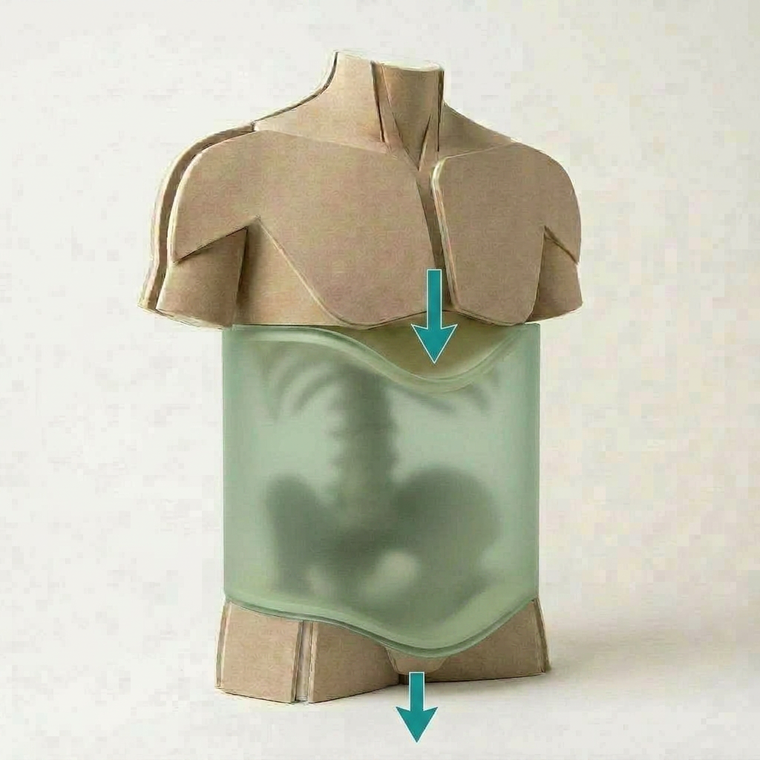
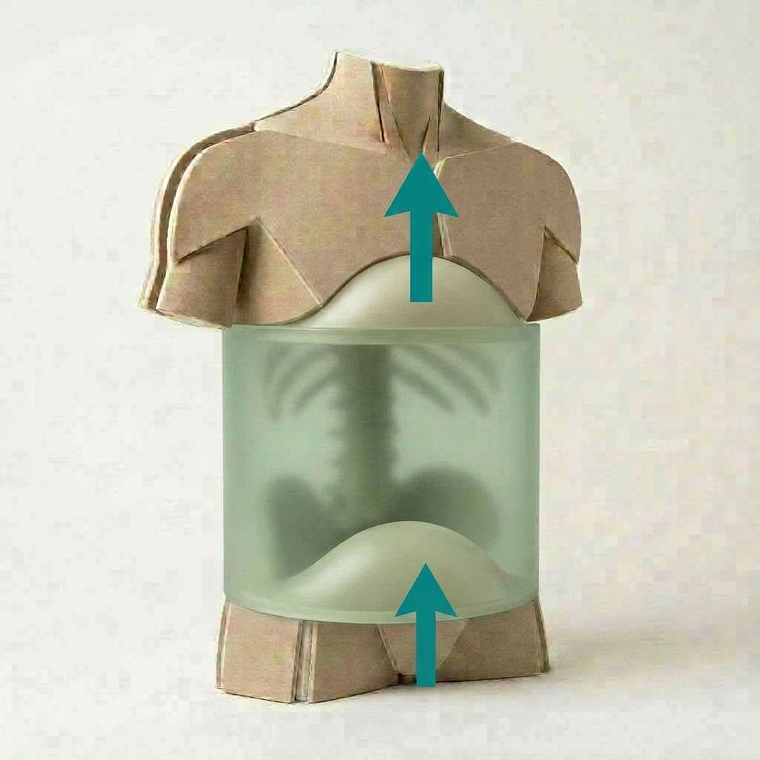
When you breathe in, your diaphragm does not lift up. It drops down. That wide dome of muscle at the top of the can contracts and flattens, sinking down into your abdomen, and that is what draws air into your lungs and makes room for them to expand. When you breathe out, the diaphragm relaxes and domes back up into your chest, gently pushing the air out. Down to breathe in, up to breathe out. It feels backwards until you sit with it, and then it never quite leaves you.
Inhale. The top of the can drops down, making room.Exhale. The top domes back up, easing the air out.
Your ribs have their own quiet motion, and it is just as surprising. We tend to imagine our ribs moving straight out and in, like a chest puffing forward. What they actually do is closer to a bucket handle. Each rib swings up and out as you breathe in, lifting and widening, then lowers back down as you breathe out, the way the handle on a bucket rises and falls at its hinges. Up and out to fill, down and in to empty.
None of this asks a single thing of your neck. That is the whole point of what comes next, because for a body like ours, the neck has very often been doing a job it was never meant to do.
Module 5 · Lesson 4 of 5
Why Your Diaphragm Went on Guard Duty
Remember from a few modules ago how a body like ours lives braced, always a little on guard against an unstable frame. Your diaphragm got pulled into that bracing, and understanding how is one of the most useful things you will ever learn about your own breath.
When your deep stabilizers are not reliably holding you, your body goes looking for steadiness anywhere it can find it. The diaphragm itself, that big dome of muscle ringing the bottom of your rib cage, turns out to be one tempting place to find it. If it locks down and grips around the lower ribs instead of moving freely, it makes a firm, braced base. It is not a graceful kind of stability, and it is certainly not a functional one, yet for a frightened system it will do. So the diaphragm quietly stops being a breathing muscle and becomes a holding muscle.
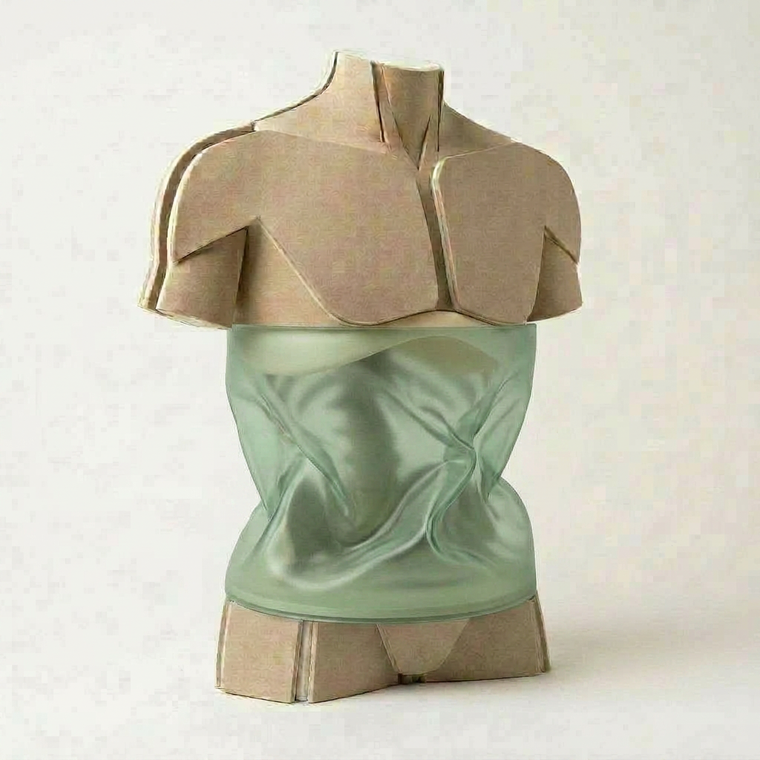
A can that cannot manage its pressure cannot hold its shape. When the walls cannot hold steady, the whole system crumples and braces.
Your diaphragm did not forget how to breathe. It got recruited into holding you up, and it cannot do both jobs at once.
When that happens, you still have to breathe, because breathing is never optional. So your body reaches for the only muscles left to it, the small accessory muscles in your neck and your upper chest, and it uses them to haul your ribs upward with every single breath. That is why so many of us are neck breathers and chest breathers. That is part of why your neck and your shoulders ache the way they do, and part of why being told to relax them never holds. They have been breathing for you, thousands of times a day, for years.
Here is where it all connects, and where the hope lives. For your diaphragm to set down its guard duty and move freely again, the sides of the can have to be able to hold steady in its place. The walls of that can are your deep core, the transverse abdominis from the last module. When that corset can gently stabilize you, your diaphragm is finally relieved of its second job and allowed to simply breathe. Your breath and your deep core hold each other steady. We do not fix one without the other, and that is not a complication. It is the quiet elegance of the whole design.
Module 5 · Lesson 5 of 5
Your Breath as a Dashboard
Once your breath begins to find its way home, it offers you a gift you did not have before. It becomes a dashboard light for your whole nervous system.
When your system feels safe and steady, your breath tends to settle low and easy, moving down into that can the way it was designed to move. When your system tips back toward guarding, toward that braced and vigilant place, your breath climbs. It rises up into your chest and your neck, quick and shallow, often before you have consciously noticed anything is wrong at all. Once you know how to feel that, your own breath will tell you what state you are in, frequently earlier than your thinking mind can. It becomes one of the most honest signals you have, and learning to read it is a quiet kind of power.
We are not going to drill breathing here, because the real practice belongs later, woven gently into the movement work, where your body can give it its full attention. For now, all I want to leave you with is an invitation, and only if it feels good. Sometime when you are resting, you might lay a hand low on your belly, just below your ribs, and simply notice. Does anything move down there as you breathe, or does it all seem to happen up high near your collarbones. There is no right answer, and there is nothing to fix today. You are only beginning to feel the can.
Your breath was never something you were failing at. It was a mechanism quietly waiting to be understood, and you have just begun.
Your Take-Away
My Breath Dashboard. A gentle tracker for noticing where your breath lives, low and easy or up high, and what that tells you about your state. No fixing, just reading the dashboard.
Next, we follow the breath outward, into the living tissue it moves through, the fascia, the quiet web that connects every part of you to every other part. I will meet you there, whenever your body is ready.
If the preview below is blank, tap Save / Print to open and fill your worksheet. Your lesson is waiting right behind this screen.
Module 1 is yours to explore freely. The rest opens when you enroll in The Movement Primer, the live group program, and it stays yours, to revisit at whatever pace your body asks for.