Bolds the start of each word as a visual anchor. Helps some people focus; off by default.
Font
Module 3 · Part One
Your Nervous System, the Gatekeeper
(and your very first tools)
Lesson 1 of 6
Listen to this lesson
Narration coming soon
A note before we begin. You deserve to truly understand the body you live in, not just to be told to calm down. So we will move through this gently, a little at a time, at whatever pace your body asks for. There is nothing here to memorize, and nothing waiting to be tested. The two tools live at the very end, and if all you have today is the energy to scroll down to them, that is a completely honest way to use this lesson.
Module 3 · Lesson 1 of 6
The Brace You Are Holding Right Now
Before we go anywhere, I want you to notice something in your own body, right now.
That subtle, upward pull through the tops of your shoulders and the back of your neck. The quiet, constant sense that they are the ones holding your head and your whole torso up, the way they have held you up through every ordinary movement of your day, without ever being asked, without ever once getting to rest. Many of the people I work with feel it the moment I name it, then they cannot un-feel it.
If that is you, stay with it for a moment. There is no need to fix it, or to drop it, or to correct it. Just let it be felt. By the end of this module you will understand exactly what that bracing is, why your body reached for it, and why no amount of sitting up straighter was ever going to undo it.
It was never a posture problem. It was your nervous system, doing the most loyal thing it knows how to do.
When a nervous system believes it is in danger, it braces. Not gently, and not selectively. It recruits everything at once, pulling the body in toward a single, rigid, protective column, because a system bracing for impact has no use for fine, sequential, unhurried control. Guarding is a global strategy. It is fast, it is total, and it is built to protect you from something that might arrive in the next half second. It is the very opposite of quiet, organized stability.
Here is the part that matters most for a body like ours. That bracing is not a rare emergency for us. For so many of us, it is the baseline, the state our nervous system has quietly settled into most of the time, because it has very good reasons to believe the danger is real, and close, and ongoing. We will get to those reasons, because they are some of the most validating things you will ever learn about yourself. First, though, I want you to see what that constant, low-grade bracing is actually costing you, because it turns out to be the very thing standing between you and your own stability. To understand that, we have to begin with what your nervous system is truly here to do.
Module 3 · Lesson 2 of 6
Your Nervous System Has One Job
Above everything else it manages, your nervous system has one job: to keep you alive. Every other thing it tends to, your heart rate, your breath, the quiet tone humming in your muscles, it tends to in service of that single directive. Underneath all of it, it is always asking one question. Is it safe here, or do I need to protect us?
This is where the most important idea in all of this work lives, so I want to say it plainly. Your nervous system will not allow your body to move in a stable, organized, precise way until it trusts that movement is safe. It simply will not. That fine, quiet kind of stability is a privilege your nervous system grants only once trust is in place. In a body like ours, that trust has been broken so many times that it has become very hard to earn back.
It helps to think of it as a relationship between two parts of you. Your body needs to trust that your nervous system will let it move and explore without slamming on the brakes. Your nervous system needs to trust that your body can move without being hurt. When those two have been at odds for years, every movement carries a little suspicion, and suspicion is not the soil where stable, graceful movement can grow.
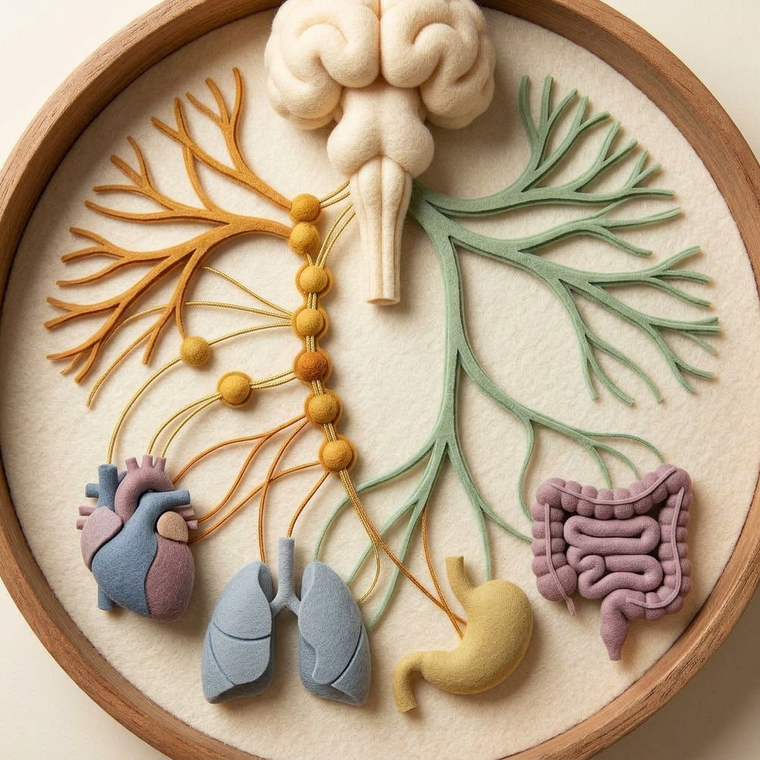
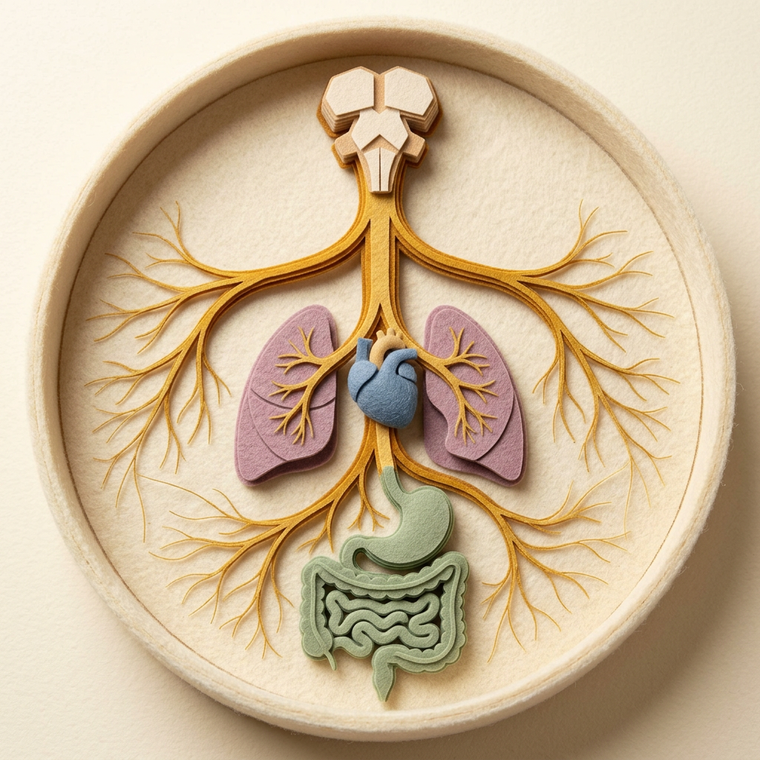
It also helps to know that the part of you running all of this has two broad settings. There is the mobilize-and-protect setting, the one that lifts your heart rate, primes your muscles, narrows your focus, and readies you to act. There is the rest-and-restore setting, carried largely by a long, wandering nerve called the vagus, the one that lets your body digest, heal, learn, and feel safe enough to finally soften. A regulated system moves fluidly between the two of them all day, leaning into protection when it is genuinely needed, then settling back down once the moment has passed.
A body like ours does not move so freely between them. It tends to get stuck, leaning toward protection, braced and a little on guard even on a calm and uneventful day. That is not a malfunction. It is a nervous system that has not yet been given enough evidence to trust that it can stand down.
You cannot reach your own deep stability from inside a system that does not trust it is safe. That is the whole puzzle, and next I want to show you exactly why.
Module 3 · Lesson 3 of 6
Why Your Stabilizers Will Not Come When You Call
Your muscles are not all the same kind of worker. Some of them are large, powerful, and built for big, fast, forceful movement, the ones that haul you up off the floor or carry you quickly away from something frightening. Others are small, deep, and quiet, built for something entirely different: holding a single joint precisely centered while everything else moves around it, all day, without you ever noticing they are there. That second group is your stability. Holding you steady from the inside is their whole reason for being.
In a body that feels safe, here is the quiet miracle that unfolds. A fraction of a second before you move, your nervous system fires those deep stabilizers first, bracing the joint softly from the inside before the load has even arrived. It is automatic, invisible, happening far beneath thought. Researchers call it feedforward control, this small anticipatory whisper of support that comes before the movement. In a hypermobile body, it runs late, or it does not run at all. The deep stabilizers never get the early message, so the support that was meant to arrive first simply never comes.
When your system is also sitting in that braced, protective gear, it gets worse, because a nervous system convinced it is in danger has no patience for precision. It wants speed, and force, and survival. So it reaches for the big, global muscles, the fast and powerful ones, and quietly locks the small, deep stabilizers behind a door it refuses to open. They are not available to a body that believes it may have to run.
So you are left holding yourself up with the only muscles your nervous system will hand you while it is braced. The big ones. The global ones. Your shoulders. Your neck. Your upper back.
That brace you felt at the very start of this module, the one living through your shoulders and the back of your neck, is that exact story, alive in your body right now. It is not a bad habit, and it is not weakness. It is your shoulders and your neck performing the heroic, exhausting work that your deep stabilizers were always meant to do quietly underneath them, the work they cannot do, because your nervous system has them locked away for safekeeping.
This is why being told to simply relax your shoulders never worked for longer than a few seconds. The shoulders were never the problem. They were the rescue. You cannot send the rescue home until the system underneath it is finally allowed to come back online. Which leaves us one enormous question: why does our nervous system decide the danger is real in the first place?
Module 3 · Lesson 4 of 6
Why Your System Believes the Danger Is Real
Part of the answer is learned. A lifetime of slips, subluxations, flares, and injuries that arrived out of nowhere taught your system, correctly, that movement can cost you. It was paying close attention. It was not being dramatic. It was right.
There is a deeper reason, though, and it is the one I find genuinely beautiful, even though it is the source of so much of the tiredness. Your brain builds its sense of where your body is in space out of tiny sensors packed into your joints, your ligaments, and the tissue all around them, sensors reporting back constantly, here is where this joint is, here is how much tension it is holding. In a body like ours, that tissue is more lax, more giving, more generous in its range, so the signals it sends back arrive looser, softer, and far harder to trust.
Picture your body's sense of its own position as a kind of internal GPS. In most bodies, it locates each joint to within about ten feet. In ours, that same system is working somewhere inside a mile-wide radius. Your brain is trying to navigate a precise world using a map that can only tell it roughly where you are.
A brain that cannot trust where your joints are does the only wise thing left to it. It stays awake. It stays vigilant. It keeps the muscles a little braced at all times, because it cannot rely on the structure alone to hold you. This is why, for a body like ours, it is a threat to simply exist against gravity. Standing upright, unsupported, becomes a quiet challenge your system is actively managing in every ordinary moment, without you ever once knowing it was happening.
Something else moves underneath all of this, too, and it is the part I never want you to lose, no matter how hard the days become. A body like ours does not only send blurry signals outward. It also takes the world back in at a higher resolution than most bodies do. The very same tissue differences that make your joints harder to locate also make you a more sensitive instrument, picking up more sensation, more of your own inner workings, more of everything, all the time. Your nervous system is not malfunctioning. It is high-gain. It was built to perceive fine distinctions in a world that was mostly not designed for that much sensitivity, then handed almost no support for carrying the gift. The vigilance and the sensitivity are two faces of one finely tuned thing.
You were never broken. You have been running an exquisitely sensitive system in a world that kept mistaking your sensitivity for damage.
This is exactly what Dr. Stephen Porges, the researcher behind what is called polyvagal theory, helped the EDS community finally put into words. The neurologists kept noticing that hypermobile people had nervous systems that looked, on paper, like the nervous systems of people who had survived deep trauma. Braced. Watchful. Slow to believe they were ever truly safe. What became clear is that, for us, there does not need to be a dramatic external threat for the system to live in that state. The instability itself is the threat. The sensitivity itself keeps the system switched on. Your nervous system has been doing the quiet, ceaseless work of feeling unsafe in the most ordinary moments of your entire life, just by holding you upright in a chair, in a line, on your own two feet.
No wonder you are tired. No wonder it braces. It has been holding you up against a world that never once felt fully solid beneath you, doing it without rest, and without thanks, for as long as you have been alive.
Module 3 · Lesson 5 of 6
How Safety Becomes Strength
You cannot order a frightened nervous system to stop bracing. It does not take commands, and every time you try to force it, you only prove to it that something really was wrong after all. So we do not force it. We do the gentler, and honestly the far smarter, thing instead. We give it evidence.
The same nervous system that once learned movement equals danger is completely capable of learning the opposite, through the very same mechanism it used to learn the first lesson. Repetition. Evidence. Every single time you move in a way that turns out to be safe, a way that does not hurt, a way your body got to agree to first, your system files away one small new piece of proof. Movement can be safe. The old prediction loosens, just slightly. Do that enough times, gently, patiently, always with permission, and your system slowly recalibrates what it believes about the world. It does not have to guard so hard anymore. As it eases out of that braced state, the deep stabilizers it had locked away are finally, quietly, allowed to come home.
I know this is true not only because I have watched it happen in the bodies I have cared for across twenty-seven years, but because I have lived it in my own. There was a night, not long ago, when my body did something on my own floor in the middle of the night that it had not been able to do in years, a slow, articulated, controlled movement that simply is not available to a guarded system, arriving completely without my effort and without my permission. I wept. Not because of the movement itself, but because of what the movement meant. My body was telling me, in the only language it speaks plainly, that after years and years of this work, it finally trusted me enough to stop holding.
You cannot move like that while your body is bracing. The strength was never the thing I was missing. The safety was. The strength is what becomes possible once the safety is real.
That is the whole arc of what you and I are doing together. We are not going to strengthen you into stability. We are going to make you safe enough that your own stability becomes available to you again. That is what I mean, every single time I say it, by safe enough to get strong.
It is also why everything we do is built on permission, and on never pushing through. Those are not soft niceties I offer to be kind. They are the actual mechanism of the entire thing. Pain and force feed the threat, and the threat keeps the gate shut. Safety and choice are what swing it open. The gentleness is not the wrapping around the medicine. The gentleness is the medicine. Which brings us, at last, to something you can begin doing today.
Module 3 · Lesson 6 of 6
Your First Two Tools
You can begin shifting that gear today, before any exercise, before anything that looks remotely like working out. These first tools are not movement at all. They are quiet ways of speaking to your nervous system in its own language, the language of safety, rather than asking your thinking mind to relax, which, if your mind is anything like ours, has probably never once worked on command.
They reach your system through the nerves of your eyes and your face, which run on a direct line into the brainstem, the oldest, deepest, most protective part of you. They may feel a little strange, even a little silly, which is completely fine. Strange only ever means unfamiliar, and unfamiliar is exactly how we know we are reaching something that has never been reached until now. There is nothing to get right here. You are only ever noticing.
Tool one, the eye gaze. Your eyes are wired straight into the circuits that set your entire level of alertness, which is why where you let them rest sends a real, physical message about whether it is safe to settle. Keep your head facing forward, soft and still. Now let just your eyes drift to one side, to the right or the left, and find a comfortable place to let your gaze land. Not straining toward anything. Just looking. Then you wait. You are waiting for a small signal that your system is beginning to let go, and it almost always comes on its own, right when you have stopped trying to make it happen: a deeper breath that arrives without you asking for it, a yawn, a sigh, sometimes your eyes watering just a little. Those are the outward signs of your nervous system genuinely shifting gears. It can take up to a full minute, so give it room. When the signal comes, bring your eyes slowly back to center, rest, then offer the very same thing to the other side. If at any point it feels like too much, you simply stop. That is always, always allowed.
Tool two, gentle pressure. Bring your thumb and forefinger to the bridge of your nose, right where a pair of glasses would sit, and squeeze, gently, just enough to feel a soft and almost pleasant pressure, never anything sharp. There is a second spot you can try as well, at the base of your nose, just above your teeth. These places are served by branches of a nerve that has its own quiet line into those same deep safety centers, which is why a little pressure here can coax your whole system toward calm. As you hold, let your attention drift lower, into your chest, into your shoulders, because that is so often where you will feel something let go. Hold for thirty seconds, or a minute, or however long feels good to you. You are welcome to close your eyes for this one, if light or screens are asking a lot of you today.
The only homework is the gentle kind: as you play with these, simply notice whether they seem to help. Maybe that shoulder brace from the start of this module softens. Maybe a headache loosens its grip. Maybe nothing obvious yet, which is also fine, because your system may need many more repetitions before it trusts the new signal enough to answer it.
Your Take-Away
My First Regulation Tools. A printable card of your two gentle tools, with a no-pressure log to notice what helps. Keep it by your bed, or in your bag, for the days your brain cannot hold the steps.
There are deeper layers of this work waiting further down the road, some that pair these tools with movement, and a few I only ever teach one to one, because they need my eyes on you, especially when a neck is having a hard time. We will get there together. Next, we walk through that door and down into your core, to meet the specific deep muscle that has been locked away, the one researchers have actually measured going quiet in bodies like ours. I will meet you there.
If the preview below is blank, tap Save / Print to open and fill your worksheet. Your lesson is waiting right behind this screen.
Module 1 is yours to explore freely. The rest opens when you enroll in The Movement Primer, the live group program, and it stays yours, to revisit at whatever pace your body asks for.